Hello to all the new visitors coming over thanks to my mention on Whip Up. I should do more tutorials if they are this popular!
And also thanks to all the new commenters who have passed by recently and thanks for the birthday wishes from the other week. I’ve not got time to reply individually at the moment – but I do really appreciate you all.
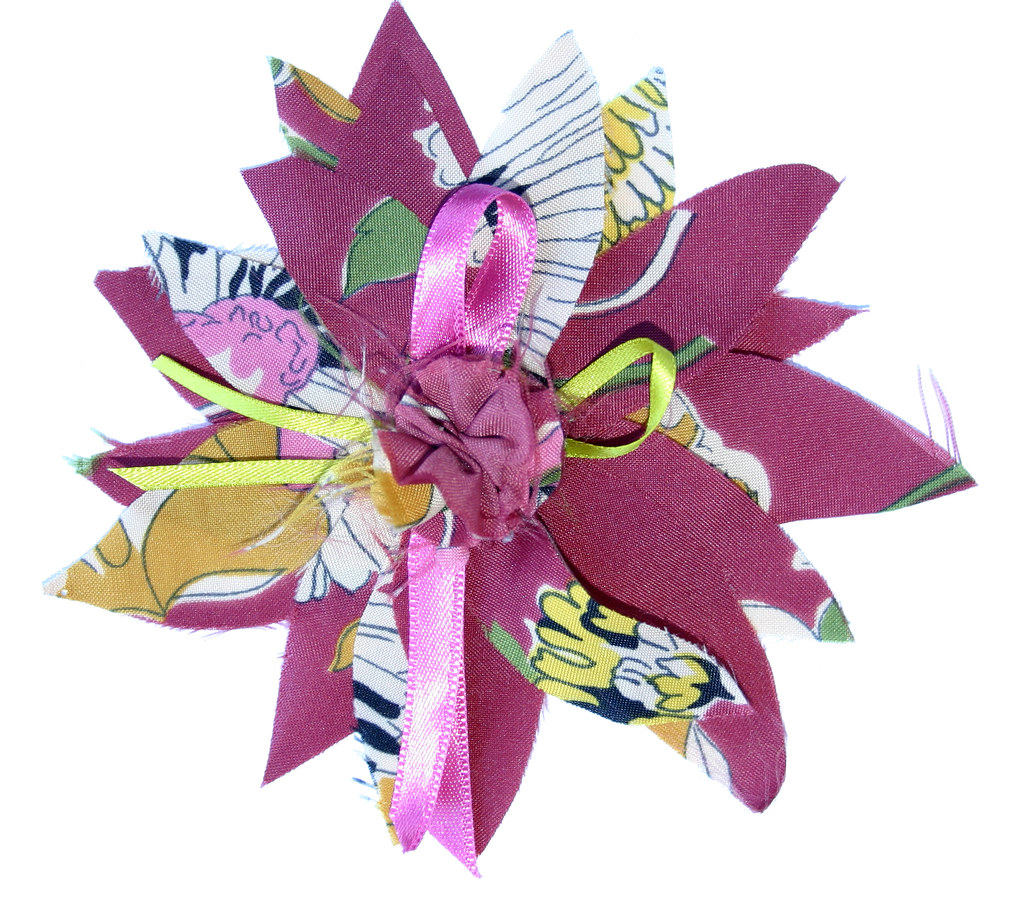
Talking of comments, I wanted to answer one from Fashionista from a week or two ago about my new range of corsages for Enamore. I haven’t been able to reply directly as she left no email address, so will do so here. I do feel it’s important to answer it in the main body of the blog not in the comments, so other people can join in….
- fashionista said…
-
I am an 18 year old student and i am designing a similar corsage to what you make.I have already made a mock up and the total cost was under £1. If you are using recycled materials-then why the extremely high asking price?I do not see the logic.Recycling items are meant to be cheap!
OK. Point 1
Designing similar corsages to those that I make *could* be a copyright infringment. Please be aware that I am a professional designer-maker, and my designs are my own. Please don’t copy my work for commercial or professional gain. This applies to everyone – I am not aiming this comment specifically at Fashionista, it’s just a point worth making here.
Point 2. Recycled fabrics and relative cheapness. I don’t use recycled fabrics because they are cheaper. Often I pay more for the recycled fabrics than I would for equivalent new fabrics. There is more effort and processing involved in using recycled fabrics, which adds to their cost (see below). I recycle because I believe in making minimal impact on the environment with my work.
Point 3. The price. OK, let’s go through this in detail.
a) I am a professional maker. I make a living doing this work. I have to make a living wage. I have to charge for my TIME. For each piece I make, I cost it according to my hourly rate. This rate is worked out through various means:
- How much I need to earn to live
- My business overheads – studio rent, machinery, bills, insurance, photography, marketing costs and advertising, website development and maintenance, postage, stationery, packaging etc. Believe me, this adds up to A LOT.
I work out my annual overheads, income and required living amount and base an hourly rate on how many hours I am able to spend per year actually making. This doesn’t include the other stuff like marketing, answering blog comments, travel and of course time off. So this brings me to an hourly rate.
So each piece is costed in the following way:
Materials (which is often a small proportion of the final cost)
Labour
Add these together and add 10% profit (roughly). This 10% is the only actual real profit I maker per piece when selling wholesale. It usually is less than £3 ($6).
This makes the wholesale or trade price. This is the price I sell my pieces wholesale to a shop for. When a shop buys in work, they have to make a profit on it themselves and they add a mark-up, usually at least double the wholesale price. Often it is more than this, though some small shops put less mark-up on.
When I sell products directly there is no shop mark-up involved, so I get to keep the mark-up myself. I have to sell the products at pretty much the same as the shops do, otherwise I am undercutting the shop and they would be entitled to be annoyed, and refuse to stock my work any longer.
That’s how a corsage that has material costs of £1 costs £25 when sold in a shop. That’s why handmade products made by professionals cost more than mass-produced, and why equally lovely handmade products sold by non-professional makers can cost a lot less.
Most people don’t know this, and that’s why there is such a problem in the craft world about pricing. Have a look at this factsheet for more information.
While I am on this subject, I also want to mention why I don’t give out patterns for my designs – I do get asked a lot, often on Flickr. All my original designs are things I sell or intend to sell, therefore I don’t want other people making them! I do teach some of my techniques and designs, but I get paid for that and make it clear that my designs are my copyright. Where I have worked out a pattern from another piece (usually historic and by an unknown maker) I sometimes make the pattern available, again through teaching. I would be out a job if I gave away all my secrets! So the answer is either to come to one of my courses, or wait for me to get a book published with all this stuff in it.
I don’t mean to be unhelpful, I just need to protect my copyright and my brand and make a living! I’m happy to offer help and assistance where the request is reasonable. I love teaching and helping textile enthusiasts achieve creative heights. I would (will…) put more tutorials on this blog as and when I have time.
Do feel free to leave your comments about any of this, or email me if you want a direct answer. (ruthATruthsingerDOTcom)


 Ruth Singer
Let me know what you think