My Cultures of Care project wasn’t intentionally all about nature and landscape connection, yet that is what a lot of it has turned out to be. This podcast episode, and the essay below, is my exploration of how nature, outdoors and landscape in its widest sense have influenced my work. I talk about projects on landscape history and community projects making in nature and with nature.
This was part of my Cultures of Care Group session for August. The next sessions are open for bookings now in September, October and November are open for bookings now, and I would love it if you could join me then. The sessions are free.
After the talk we had a really amazing conversation among the group about the differences with working outside to working inside, and about where these projects are going to travel to in the future.
As mentioned, a new Making Meaning Journal, in printed and digital versions will be out in a few weeks with more in-depth explorations of some of the projects I talked about here and some which I didn’t get to. I’ve also got my Places & Traces local project in Leicestershire happening over the next 9 months, as well as my residency will Mill Field Forest Garden which is just getting going.
You might also like to read my blog posts about recent nature-based projects and activities. There are some links at the very end of this post.
The next Cultures of Care group session is Weds 25th September at 1pm. In that session I will be talking about productivity, or the rejection of it, in my creative practice, about care in creativity and about the why not the what of creative work.
Play here
Download the full transcript here
Nature & Care
Over the last few years, my creative projects have been about criminals, about genetics, about grief and loss, about quilts and history and museums. I loved all of those themes, I found many stories to tell and so many objects to make. But they were all indoors. I love my studio, working in museums and archives but I love being outdoors. Whenever the weather isn’t awful, I get torn between wanting to be in my studio and wanting to be outside.
It’s been there for a long time, this need to be outdoors more, to connect nature and my work more closely. I tried, years ago. I tracked my walks on GPS to do something visual with but it was too techy for me and I didn’t go any further. I made a few artworks with plant parts like ash keys. I made a sketchbook of my walks in my local urban edge lands in Leicester. I booked a retreat in a cottage on a cliff in Cornwall to walk and to work, to figure out this conundrum of the outdoors in my head and how to make it into my studio. I spent 2 days deep in thought across those cliff tops and sitting on beaches. I realised that the connection I wanted to explore was with my local landscape, the hills and fields and woodlands and granite outcrops and quarries and hedges, not the wild coasts of Cornwall. That was wonderful, but it wasn’t my creative space. It wasn’t my homeland. In the end I concluded that I had enough projects to do already and I didn’t need to turn my love of walking into my work as well. That could just be walking. Not everything has to turn into artwork, not everything has to be an inspiration to make and create. Walking could just be. I could just be.
That was seven years ago. I let go of the idea that walking could be part of my creative practice. It was just my escape from the city, from the confines of my inner-city home. That only became more stark in lockdown, with the extended local lockdowns that Leicester was hemmed in by when the rest of the country got to go on summer holidays. I found the city confines suffocating. My urban edge lands which I had so enjoyed when I could ramble amongst them out of choice now felt like the grim, dirty, post-industrial wastelands that they are.
In 2021 I moved house. There was no rural cottage dream for me, I could not remotely afford a place in a village round here, but somehow, through enormous luck and a housing-price bubble , I could just afford to leave the city and to settle into a small house with a good-sized garden on the edge of a modest town, where I can pretend I live in a village because the woods are as near to me as the supermarket, a mile and a half in opposite directions. Life has changed a lot in those three years. And so has my work.
As I explored my new local area, places I kind of know, had known all my life, but didn’t really know, I found new creative ideas creeping in. I got to know local projects and natural places. In 2022 I devised a wonderful online sharing event called Making Meaning Live, bringing together artists and makers to talk about their work and how they create meaning. Some of them shared work about the natural world, taking meaning from other beings and from the places we inhabit. I started connections with Peace of Green, a wellbeing in nature community project, I travelled to my friend’s woodland and smallholding in mid-Wales, I walked the woodlands and hedgerows of my local area and I put my roots back down in this landscape where I grew up.
After Making Meaning Live I started to re-evaluate and redefine all of my work under the banner of care. I hadn’t seen it like that until someone said it to me during Making Meaning Live. I had commented that other artists were talking about care, expressing care through their work, and it was reflected back to me that so was I. Creating the nurturing and inspiring space of Making Meaning Live was care practice. So I ran with it. Or maybe I walked, slowly and mindfully with it. I reworked a funding application that had been bubbling for a long time to include nature-based working through two slow residencies with nature-based groups alongside museum projects, community engagement and other far too many things to be possible in the 2 years of funding. Of course I over-committed, of course I had more ideas than were remotely possible. In the end what has actually come from my Cultures of Care project (as it became) is mostly land and nature-based. There are other elements to the Care project, this event and the podcasts series, publications like Making Meaning Journal, research projects on other themes, artist support and development and my own creative learning journey with coaches and courses. What didn’t happen though are the museum projects, for various reasons. That’s been a bit sad for me as well, I didn’t want to let that go. But on the positive side, I have two other completely different museum projects in the pipeline now, one I’ve very much started and one which starts next year, so I am not short of museums and historic textiles at all.
I haven’t let go of my grasp of history in my projects though. Working with historical stories is a care practice. I realised this with my Criminal Quilts project where I was working with the often difficult life stories of women held in Victorian prisons and I felt a responsibility to approach their stories with care. Academic history practice doesn’t really allow for personal responses and the exploration of the human story if there is no evidence about this in the records – there was nothing in the prisoner women’s own words in the records I used for Criminal Quilts, so then the role of the artist is to put that back, imagine and create emotional stories, treat them with care. That’s been pretty liberating to me, who trained as a historian, to allow myself as the artist to fill some of the gaps in historical information with imagination and above all, with empathy. Archaeology is similar, you can only go on the evidence that survives and it is us humans that add the personal and emotional back into objects or landscapes that speak of human lives in the past.
Let me take you back around 500 years to rural England and the small (to us), self-sufficient villages that scattered the landscape of, for example, East Leicestershire. Actually, I won’t go back that far. I’ll go back about 35 years to when my historian dad took me, a mid-teens budding historian, to the remaining sites of those once thriving villages. Today, and in the early 1990s, they are green fields, mostly. Sheep pasture. 500 years ago the villages were cleared, the people evicted, the houses knocked down and the land they had lived and grown on for generations was turned into sheep farms. I’ve known about these ghost villages for most of my life. I’ve visited many, I’ve studied them in my university degree from a historian’s point of view and I’ve read archaeological reports about them. Before my care project even started, I was thinking about deserted medieval villages and about relationships to land and place – both my own personal history and the people who lived in these places. A couple of years ago, wanting to explore this more, I set a creative brief for my Maker Membership of Land. Not landscape, the visual, aesthetic meaning, but land as in earth, soil, homeland. I am interested in the connection with land, with the earth, soil, rocks and skies of the place we belong, or the place we have come to belong.
Artwork and creative projects about the connection to land came out in the Making meaning live events too, Sharon Adams shared a walk around her Northern Ireland family farmland and Kathryn Parsons focussed on the wildlife and history of the east Anglian fenlands where she lives. As I thought about this historic story of villagers being evicted, I was drawn back to the personal experiences and the unknown stories of those people having to leave where they grew up, where their ancestors were buried and the only land they knew. There are of course so many recent and current resonances as well, displacements and forced removals from land are horribly common still today, very few people actually have rights and security to exist without difficulty in the place they call home. This is something I care deeply about, my own grandmother walked away from her homeland, although as her people had been displaced for generations, it’s hard to know what kind of a relationship she might have had to the village where she grew up. But no one wants to be a refugee, stateless, without a place to call home. Although I am looking at hundreds of years ago with my medieval villages project, the stories, the personal experiences I am illuminating, are universal, across centuries, across cultures and across the land mass of earth.
A year or so ago I was developing this work to be part of an exhibition called Hearth & Home, an exploration of a range of projects and artworks about home and safety. It didn’t actually happen in the end which was disappointing and somewhat energy and creativity-sapping. The medieval villages work though did continue, and has become ongoing work which will continue to develop. My focal point throughout this long, slow, project has been the hearth, the heart of the home, the fire that heats, cooks, warms, lights, sterilises, disposes of waste. In a medieval home, and in most others before and since and still today, a source of heat is essential, and has been until very recently, a flame, a fire. What struck me with the medieval evictions was that the fires, the heart of these homes, went out. Gradually or all at once the fires stopped burning, marking of the end of the village, the end of this being home. I made a series of small log-cabin patchworks symbolising those homes, with the hearth, the square at the centre, in red. Log cabin is a much later, American patchwork design, it’s not remotely medieval, but I like the connection with the homes made of wood, of local vernacular materials, and the hearth at the centre – this red square being common in American log cabin piecing. I took the hearth cloths back to the site of a lost village and photographed it there. I’ve made an apron with houses marked and the routes the displaced people walked to their new lives, their new land. I’ve made bundles of sticks, firewood, collected from lost village sites and bound with wool and fragments of stories of those people whose homes and livelihoods were taken. I’ve used wool for most of these as it was the wool trade, the success of our cloth-creatures that caused the loss of most of the villages as landowners found sheep more profitable than people. I’ve made a jar, like an archaeological deposit, layered with meaningful materials and fragments – soil, wood, charcoal, leather, hair and personal pieces of human history like thimbles and buckles, the fragments humans leave behind in the soil. And I made a shroud, a woollen blanket with fragments of stories embedded within in, in memory of those left behind, those ancestors who couldn’t walk away with their living relatives and who stayed in the ground.
Although I’ve completed a body of work about this aspect of human experience, I know there will be more to come as I explore all kinds of associated stories, and in particular the traces on the landscape of lives long past. The interactions between humans and the natural world, the space between nature doing its own thing and humans trying to control nature is really intriguing to me as well. There’s a lot of that in the landscape, a lot of what seems like nature which is actually manipulated by humans for our own purposes. Gardens. Farming. Managed woodlands. One of those spaces of intrigue for me is hedges. Planted by humans, often a couple of hundred years ago and persisting, in various states, around most of our farmland and leisure land, at least in this middle bit of England.
Some of you will know about my hedge-obsession, it turned into Blossom & Thorn, a hedgerow homage. This was my first defined nature-based artwork project. After a couple of years living in this agricultural and wooded landscape, I had spent a lot of time with hedges. I hardly saw old hedges in my urban explorations. In the city I researched urban trees, parkland and pockets of old woodlands in the city edges. Here hedges dominate the landscape, in as much as rows of often threadbare shrubs can dominate. They are so ubiquitous that we hardly notice them, when we are used to them edging every field and path. So I chose to notice them, to encourage others to notice them too. I created a hedge spotting guide and invited others to walk their local area and investigate the hedges they encountered and share what they discovered with me. This project touched on local history, land use and ownership, tree health and folklore, personal memories and so much more. I used the data collected to create some of my pieces in the series, finding new ways to interpret experiences and places. I also responded directly to some of the hedges I met on my walks to new places across the National Forest. This project took me to literal new places and metaphorical new places of investigation and exploration of the deep narratives within our landscapes. Although all the work was physically made by me, the narratives and the data within in has been collected by others, I am a conduit of the hedge stories that were shared with me. I loved how much this project inspired new ways of looking at hedges and at the wider landscape both for those actively involved and for those who have seen the work and learned about hedges through this project. It’s a year on now and people still ask me about the hedge project and say how much they loved the concept and the way I approached it. This was not a scientific research project, it was about observation, connection, exploration, being outdoors and thinking about how different hedges, different layers of history within them, connect to us today. We tend not to notice what we’ve got until it’s gone. I hope this project with have encouraged noticing the hedges while they are still there, as well as remember the ones that have long gone.
That project really led the way into the other nature-based work I am doing for Cultures of Care – and emphasis on noticing, connection and emotional engagement and collaborating with others. I have recently started Places & Traces, a community project in which we are creatively mapping the emotional and personal histories of Charnwood Forest, the landscape in which I live. This has developed from the hedges project and from my own period of research and creative work embedded in my home landscape. I am hosting walks and wild workshops in the local area, introducing people to new places, new ways of experiencing and noticing those places and gathering their thoughts, emotional and personal histories of the places we share. This project isn’t about one type of feature, or even one small place, it’s wide ranging across about 30 square miles and it will include whatever the participants, my collaborators, choose to share and incorporate. What feels most impactful to me is the invitation to think about the places we know and love and the opportunity to share things about the place we live that we might not otherwise think to share. Projects like this uncover so much from facts and information to experiences and memories and they always inspire me so much. Creating in collaboration is always a caring process for me, and learning to create in collaboration with nature as well as people has been really exciting for me over the last couple of years.
All these projects intersect and interconnect and cross-fertilise with each other to create new ideas and new connections between me and the land, in ways I did not expect.
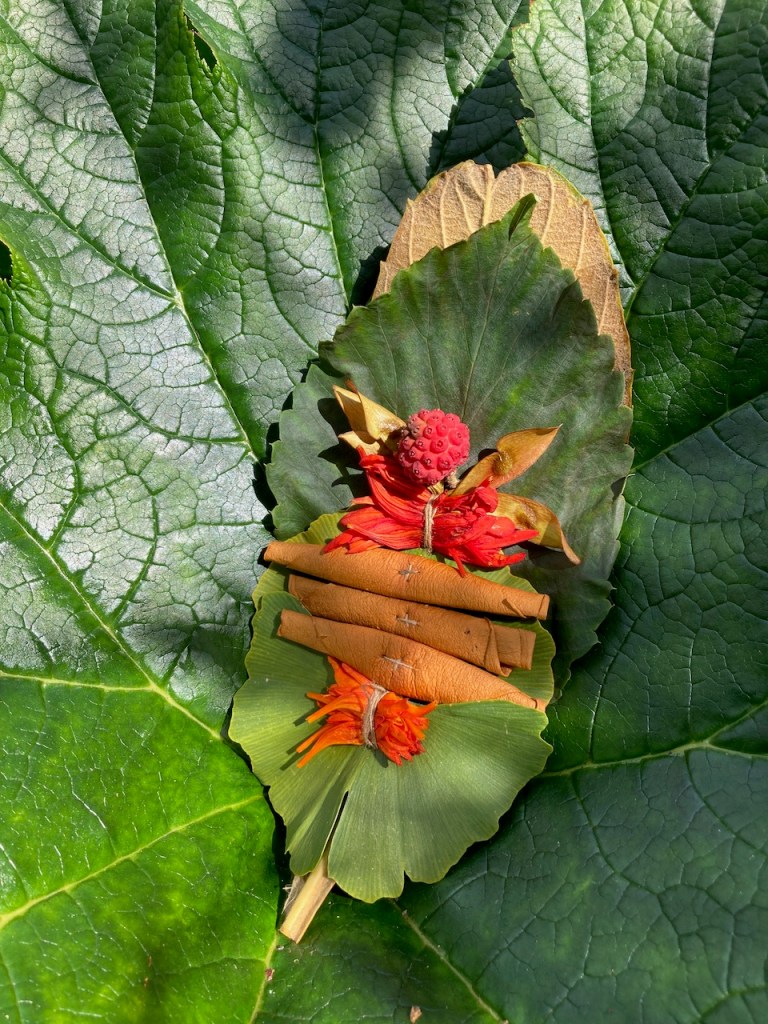
At the start of the Cultures of Care project I planned two year-long, slow projects working with groups, engaging with the landscape. Neither of them have worked out how I envisaged, how I proposed them and they have grown and changed for the better. I have just finished my first year’s residency with Peace of Green and their Wellness in Nature group. I’ve come to realise that it wasn’t so much a residency as me being a long-term visiting artist joining the group. I initially thought we would create a new group and do research projects and walking and so much else. But in the end it worked out that they had a new regular session starting and I decided to be the visiting artist at their ongoing project once a month. I soon also abandoned the idea that we would follow a research project of my devising and I allowed the time and space to see what developed, what the participants were interested in, rather than going with a fixed plan that I wanted to achieve. What has transpired has been a wonderfully nourishing engagement with people and place, focussed on nature connection through creative means. I’ve allowed the project to develop organically and I’ve allowed myself to try completely new things that I am interested in exploring and seeing how the participants feel about them. Most of the time we’ve used the materials we find in the gardens and woodlands, rather than textile. I’ve been sharing ideas and ways of seeing, experiencing and playing with and in nature, rather than teaching a technique or a process. It’s been liberating for me and based on the responses, inspiring for the participants and the group leaders as well. We’ve talked about spring and new growth and made nests from plants. We’ve explored our senses and our feelings in the garden and made sensory maps. We’ve talked about feeling safe and grounded and made amulets of protection from seed heads and leaves. We’ve thought about how humans can see more shades of green than any other colour and we made thread-wrapped sticks matching the greens we see to the colours in the thread box. We’ve explored the gardens for signs of fragility and natural decay in plants and made cyanotypes of damaged leaves. We’ve talked about how we feel in this group and in this garden and made words from twigs, berries and winter leaves. We’ve meditated on a single autumn leaf and drawn pictures or written poems in praise of the tiny details we notice when we slow down and pay attention. We’ve chosen words that inspire us when we are in the natural world and pierced the letters into dry magnolia leaves and shone a light through them to illuminate our connection to the natural places we love.
Being a visiting artist over 12 months with an existing group has been far more enjoyable for me, far more caring to me than other short-term projects. Most community engagement things are either one-off workshops for a group with the purposes of sharing a specific technique or making something finished, or are short-term interventions, every week for 6-10 weeks. While there are benefits in these ways of working for the participants, it isn’t for me. I believe that slower engagement is better for everyone and allows us to be gentle, caring and pace the work according to the seasons of our own lives and the natural world. The group I’ve been working with use different indoor venues in the winter for entirely sensible, practical reasons but it really hasn’t been as creative or as relaxed as the outdoor events. With the outdoor sessions, the role I’ve created for myself is to introduce an idea – fragility or new growth – and a simple hands-on activity with natural found materials to explore that idea with. In the outdoor sessions this has worked really well, with participants taking their time to explore the gardens, test out making and get absorbed into the activity. Indoors the sessions feel completely different, with a need for more resources, more activities, something new to do and a lack of interest in going outside in the rain to collect things. When we are outside, it is easier for the participants to simply be. Looking at the resources and examples I bring and made, paying attention to the trees, listening to birds, noticing and relaxing, taking ideas from me but being exploratory and independent. Indoors it feels like a traditional workshop with more interaction and stimulation needed. This time outdoors has very much inspired the projects that I’m doing in the second half of my project and how I work myself, as I start to use natural materials and outdoor places as much as textiles. I’ve been making temporary responsive artworks from the plants in my garden and elements from the wider landscape, all of which feeds and nourishes my creativity and connection.
Also over the last year I have been working with artists Mandeep Dhadialla and Karen Logan on two collaborations for my Cultures of Care project. Both have been land-based projects, in very different ways, and both have taught me so much. I can’t explore both of them in this session as there’s so much to say. Those projects will both be featured in my next issue of Making Meaning Journal, which was supposed to be quarterly but seems now to be annual.
I’ll also share some of my other work about land and nature and connections, including sharing the early stages of my second slow artist residency with a community forest garden, which I started this week. That’s another year of taking it slowly, seasonally and seeing what happens. I don’t know exactly where that will lead but I’m excited to find out.
Related blog posts
Creative Nature
Exploring land and nature-based projects for Cultures of Care I missed July’s Cultures of Care Group. I had to cancel because I had covid and had no energy for sharing my reflections on my care projects at the time. I’m better now, luckily, and looking forward to connecting again with a wonderful, supportive and engaged…
Walking the earth
Reflections from Places & Traces August walk Places and Traces is about exploring connections to the landscape we live in. In early August the project took to the footpaths near Woodhouse Eaves in the heart of Charnwood Forest. I lead a short walk through village edges, fields and farm tracks with the invitation to think…
Emotional Landscapes
Places & Traces is part of my Cultures of Care project. Part of Cultures of Care is care of nature and landscape, place and belonging. I’ve been working for a year now with a wellness in nature group and wanted to build on what I’ve learned in that residency to create something more focussed on…
Cultures of Care Film Launch
I’ve got a lovely new film to share about my Cultures of Care project. I wanted to create a film which captured slowness, care and paying attention that inform my project, rather than focussing on artworks or techniques. This film was made with Richard Foot and I think he’s done a great job of capturing…
Blossom & Thorn
a hedgerow homage for the National Forest An exploration of the extraordinary and humble hedgerows of the National Forest with artist Ruth Singer. Throughout Spring 2023, Ruth & a team of volunteers met with hedges along the National Forest Way and shared their stories. From this gathering of hedge learning from old maps, from observation…
Places & Traces
Creatively mapping personal and emotional histories of Charnwood Forest Over the last 12 months I have been running Places and Traces, working with a group of explorers investigating our shared and personal histories of Charnwood Forest. Places & Traces is a creative exploration of our personal and emotional histories of Charnwood Forest. Over 12 months…


 Ruth Singer
Let me know what you think