A few weeks ago, on a Sunday afternoon, I came out of the Antique Textile Fair tired but still craving more textiles, somehow. I was replete with looking at, touching and indeed buying lovely things, and my brain was buzzing with the ideas that always flow when I’m surrounding by inspiring cloth. And I had the second-hand energy burst of spending half an hour in the company of the irrepressible Isabella Rosner and her textile joy but the body was tired. I wondered down the road and happily meandered into a branch of Waterstones. I wanted more textiles but couldn’t deal with more visuals and needed to sit down, so a bookshop was perfect. When in a textile mood, I can bypass my usual honeypot of nature writing and focus in on what little there is in the textile area of bookshops. I identified the craft and the fashion sections, alongside each other, in the hope of narrative non-fiction about textiles, like the shelves and shelves of narrative non-fiction about nature. This is of course hope over experience. I know there will not be even one shelf of such books. There usually isn’t even one, or at least there isn’t even one that I haven’t already devoured (like both of Clare Hunter’s books, one of which is usually completely hidden in the history shelves). There are a lot of craft books, technique books… I do appreciate this genre, I’ve written three of them, but it’s not what I want or need now. I enjoy Batsford’s textile art series more than others as they are more about exploration of ideas than how-to, but they are still not narrative non-fiction and they are not textile history. I want more words these days, rather than pictures. I am seeking ideas and reflection more than making-inspiration. In general, bookshops like Waterstones have more interesting books in the fashion section than the craft section, although I have zero interest in contemporary fashion designers themselves – my interest in fashion wanes in about 1930. One gem does jump out though, The Dress Diary of Mrs Anne Sykes which I am excited to read but I have it on reserve from my local library so I choose not to spend £11 on this and save my money for something I cannot get from the library.
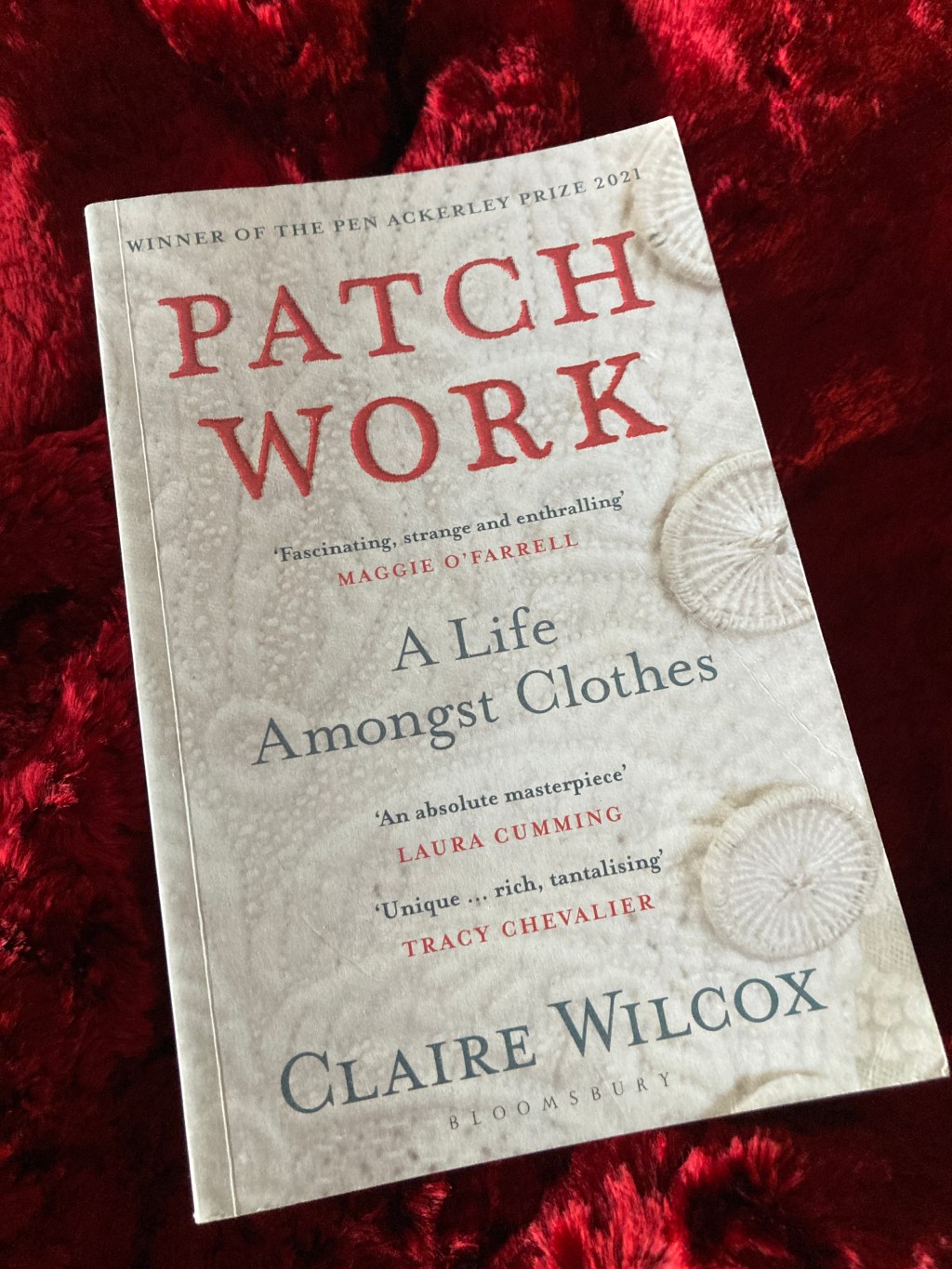
Next to catch my attention was another modest paperback amongst the glossy fashion hardbacks with a name I know – Claire Wilcox. I’d seen a review of her book Patch Work a few years ago and had clearly not made a good enough mental note of it because I had forgotten all about it until it peeked modestly from the bookshelves today. It hadn’t even shown up in my regular online searches for books about textiles, such is the minuscule niche of textile-themed autobiography. I knew Claire, very slightly, from my days working at the V&A, 20 years ago. She was a senior fashion curator, I was a very non-senior education officer so our paths didn’t cross, she would not have known me. She wrote books and curated exhibitions and was therefore a huge inspiration and role model for me. The idea of her book about clothes, about her life and about the beloved V&A was tantalising. I had remembered reading about this book, it was lodged somewhere in my woolly memory and I was delighted to be brought back to it, so I found a hard, upright seat, the only one not filled with someone on their phone (in a bookshop!), settled myself in, surrounded by literal (my shopping) and metaphorical textile history baggage (my own years working at the same institution) and started to read.
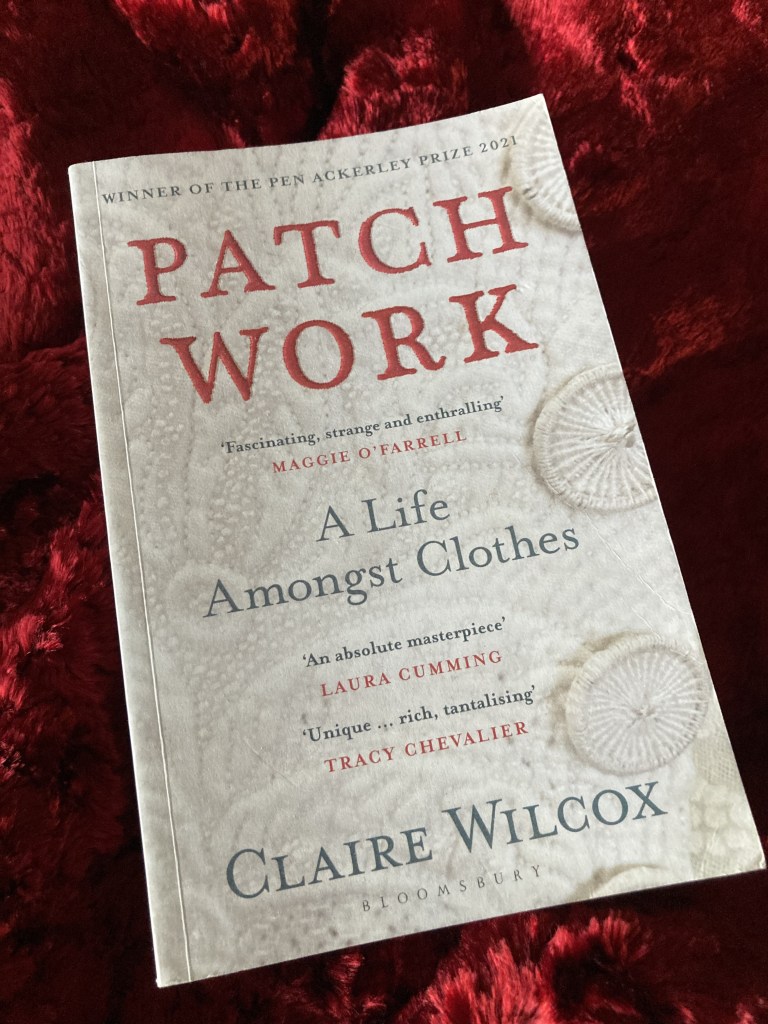
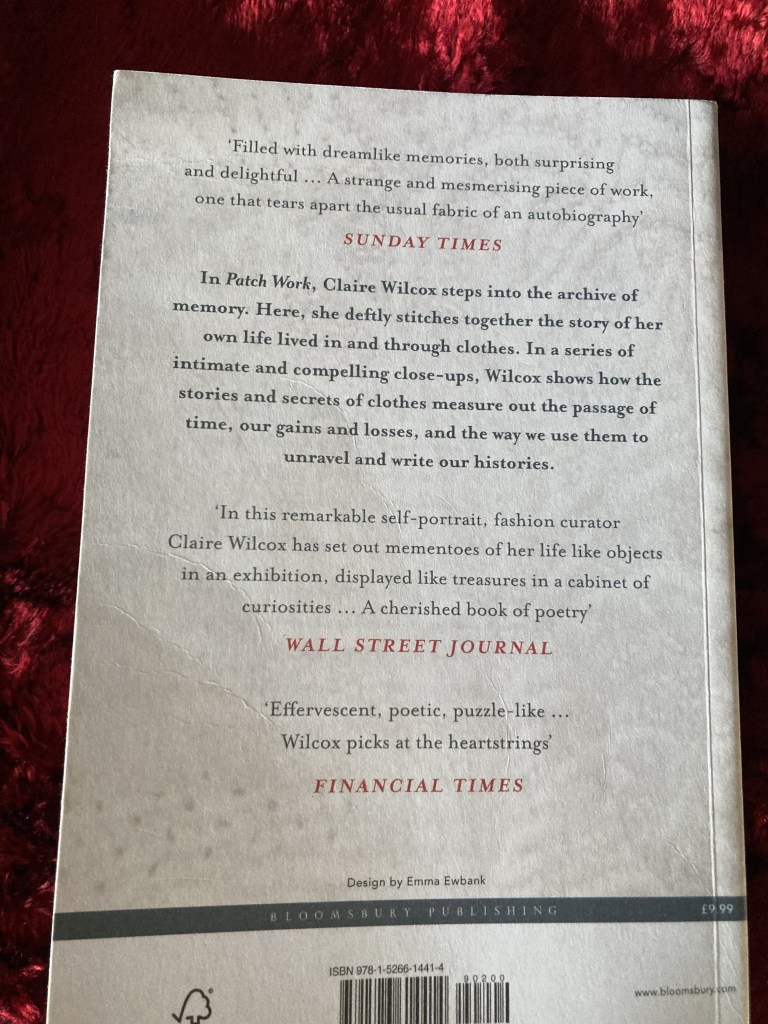
The subtitle of Patch Work is A Life Amongst Clothes, but now I have finished it, it’s clear that clothes are minor characters and the life is the main thing. Her memories, her life happening outside of the museum, alongside the clothes, is shared in fragments, remnants and snippets. These brief chapters, vignettes, are snapshots of life, love, loss and change with hints of clothes holding it all together. There are tiny windows into museum work, visual descriptions of the stores which take me back immediately to my Fridays spend researching medieval textiles on my days off, there are stories even about the floors, more than the galleries and the public face of the museum. As it should be. The life biography, chronology, is sometimes unclear and hard to follow, as though seen through sheer silk or even a thick curtain sometimes, rather than under the harsh, damaging, UV light of day. The narrative can be hard to follow, the details are vague in some areas and brightly illuminated and described in others, as life tends to be. Like with old garments, we are left to guess what the wearer was actually like, how was worn and mended. Nothing is explicit in this book, it is not a description of being a curator or a wearer of clothes. The fragments are loosely stitched together and gently presented. It reminded me of Julia Blackburn’s book about John Craske, which is disjointed and emotional rather than linear and factual. Indeed Julia Blackburn has written a some words about this book and she likens it to a ‘well-curated and eccentric exhibition’, which is about as close to my life goals as can be.
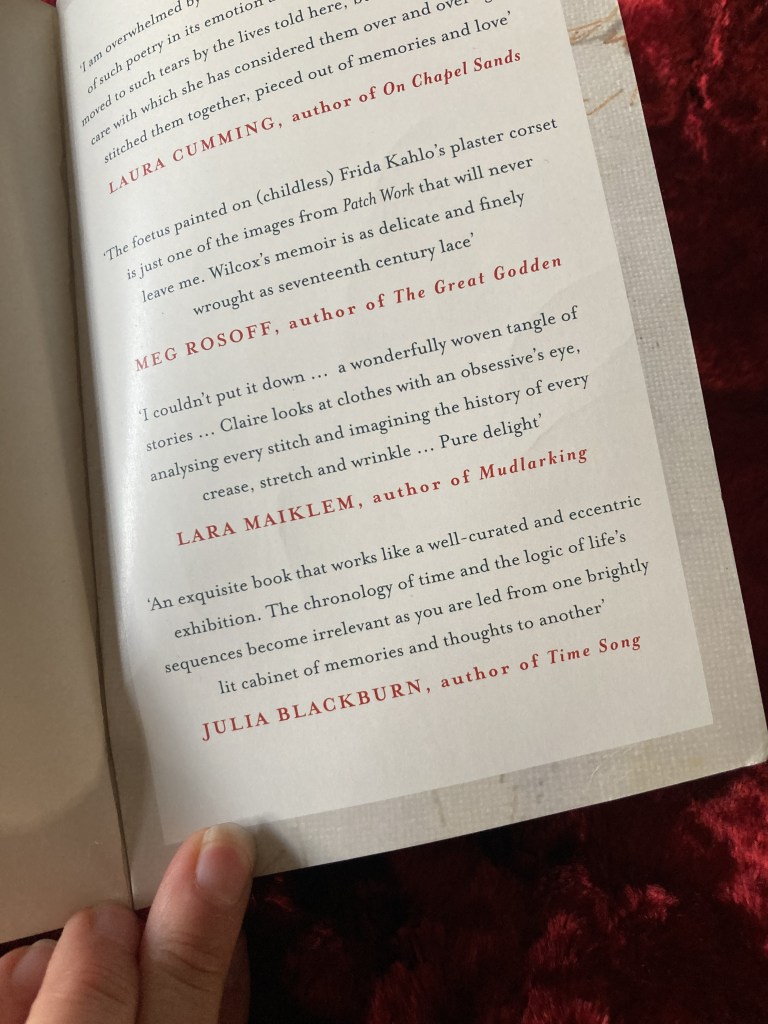
She’s right, it’s like an exhibition. This book doesn’t, can’t, tell the full story with all the facts in order, but it creates an impression, it solidifies memories and experiences and emotions into words, not using clothes or cloth as a narrative device, as I’m doing in this review, but as just there, part of life, part of her life. Other reviews describe it as poetry and biography. To me, it’s more like an artwork, a series of artworks, pieces, like I try to make, that tell stories, share memories and personal narratives without give you every detail or all the background. Each tiny chapter is an exquisite artwork, threads coming together and combine in detail and leaving some ends loose, some cloth unstitched, knowing that this does have to be a full picture or be emotive and absorbing. It is a confusing book to explain, to categorise and because of this, it feels so familiar, because my work, my way of storytelling, is hard to categorise too. I don’t know what genre this book falls into and I love it all the more for that. I want to read books about textiles but not descriptive and factual, I want to read about personal connections with cloth and memory and connections. This book feels so comfortable and pleasing to me, now I have recognised it’s similar to how I work with cloth. It’s made me realise that I don’t work with words in the same way I do with cloth. My writing tends to be descriptive and trying to get a message across. I have always thought that my straightforward way of writing stems from my museum training, from having to describe an object and it’s cultural context in 50 words, for a reading age of 12. I know I am not doing that any more, and it’s a relief, but that discipline is still part of how I present words on a page. Yet this book, Claire’s book, is also written by someone who has written museum labels and has spent many more years than me doing it. Perhaps the brevity of each chapter is influenced by the writing of short gallery texts, without rambling or using more words than is necessary, maybe that’s the poetry form other readers have recognised.
I’m reminded too of the wise words of my artist collaborator Gillian McFarland who told me it is ok for my work to be about me. Claire has written an autobiography here, in fragments, bound loosely with cloth and it is a delight. Maybe it’s more like the Antique Textile Fair, where I started, than an exhibition with a formal narrative structure. The fragments are all related but are all independent of each other, can be read, enjoyed, in any order and arranged in different ways they would still hold together. As I’ve written this, I see it is the patchwork of the title, after all. It’s not about patchwork but it is a patchwork of different bits of cloth, wildly different patterns, colours, ages but all coming together to make a harmonious whole. Claire’s patches of memory are chronological but they don’t flow on one from another. She allows the reader to explore around, to touch the different fabrics and to invent or imagine our own narrative around it. I love it, just as much as I love fragments of historic cloth untethered from a museum context, awaiting new interpretations. Like all the best writing, it is making me rethink my own work with words, and how cloth and biography needn’t be tightly-controlled and measured, but rather can be free form and organic, full of variety, shape and colour.
You can buy this book from my Bookshop.org list and I earn a little from your purchase, or you can find it anywhere else you like – but please support independent bookshops if you can.
See the other books I recommend on Bookshop.org

 Ruth Singer
Let me know what you think