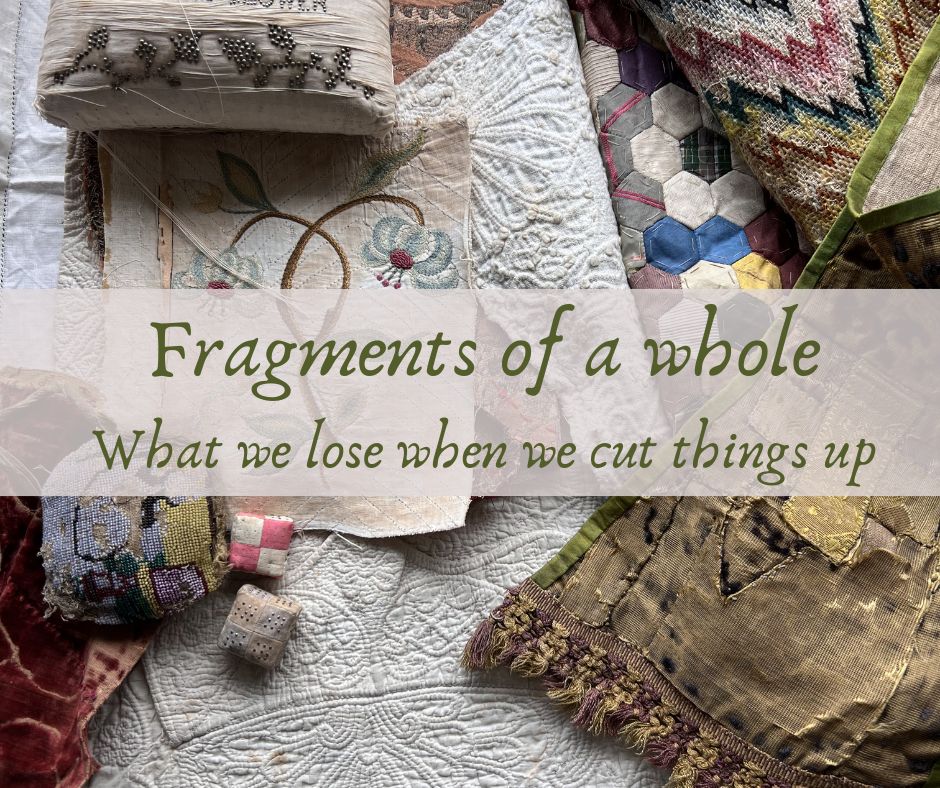
What we lose when we cut things up
As I prepare for my annual visit to the Antique Textiles Fair next week, I look back to a visit a couple of years ago and reflect on what I found, and what was missing.

I crawled out of bed horribly early, in the dark, to get a breakfast-time train to London, something I am not willing to do for anything other than historic fabrics. I’d missed the April Antique Textiles Fair with an unexpected flare up of chronic illness, which is becoming less and less predictable. I spent the weekend of the April fair feeling seasick and miserable about missing the event I had been looking forward to since the depths of winter so the trip to London, in good health, was a balm.

Manchester Antique Textiles Fair in 2018 ( my photo)

London fair from The Textile Society Website
The London fair is very different to the Manchester one, and not all in a good way. The surroundings are infinitely nicer; Old Chelsea Town Hall is glorious while the Armitage Sports Centre, Manchester is emphatically not. What Manchester lacks in style it makes up for in textiles, and people. The energy in Manchester is quite different. London was quiet. No pushing and shoving to get to the bargains, indeed none of the jumble sale-type sellers at all. It’s a lot more refined in London and a lot less atmospheric. It’s also more expensive, on the whole, which was not unexpected. Manchester has a number of rummage-style stalls, masses more vintage clothes, and far less world textile dealers. There is some overlap in dealers and types of stalls, but not that much. I missed the flea market style, the sale of collectors’ stashes of fabric, the books, the patchwork pieces (not that I need any more) and the buzz of jostling for the best bits. There was some new-to-me though, which was exciting; a stall of beautiful, old, old things, crewel hangings and exquisite embroidery and silks, all well out of my price range except a box of scraps at £10 each. I spent a long time trying to choose two or three and realising I had no particular buying plan in mind. Should I go for the oldest, smallest pieces? Should I buy the rich velvets that remind me of medieval vestments, or maybe the colourful, exciting embroidery scraps. I chose three pieces for no reason other than they were too tempting.


At times like this when I am overwhelmed with textile treasure, I don’t know if I am collecting treasure or buying materials to use in my work or if I am just over-excited and buying something because it’s lovely and affordable. I worry about these precious things ending up in the wrong hands, being made into wonky collages or Christmas angels. Does it matter? I can’t save it all, however much I want to. Am I a better home than any other? Of course I believe I am, but I would think that. I tend to buy the damaged, the pieces full of holes, the stained scraps not the pristine, however small. With these tempting treats I broke my own rules – these scraps are in good condition. A piece of orange-russet velvet which is perfect, if you ignore the fact that it has been chopped off something extraordinary. An unpicked dress fragment in brocade with silver threads, with a cut seam like a fringe around it. A sliver of 18th century white silk with a little woven flower, and a ragged edge, the hint of a harder life than the rather clean, white body suggests. A seam breaking apart while the other edge looks like crumbling paper. What they have in common is signs of use, of being sewn, cut, made into something and then being unmade again much more recently. How recently? How come? Each of these fragments is beautiful but the whole garment they came from was surely far more beautiful. What has led to this fine dress, church vestment or hanging becoming scraps in a jumble box on a dealer’s table? Who cut them up? Who butchered something beautiful to extract the most valuable parts and what became of the rest? They are separated for good now, never to be reunited. Most of the original garments may be gone now, all of the rest of it may be long gone, returned to fibres and dust-or are those larger pieces in museum or collections? Were these the only pieces still intact, with the rest of the damaged cloth thrown in the bin? Is there a dress missing a fragment somewhere? I think not. These clothes, objects, were intentionally dismembered and repurposed at some point in their life cycles. It could be just weeks ago or it could be hundreds of years since, cut up once out of fashion to remake afresh with bits left over to go in the scraps box and knock around for decades. I didn’t ask the dealer where they all came from, if the box of bits came together or were her assembled pieces from a workshop. I wish I had.
To make a dress always leaves bits and pieces but by remaking, the cloth is enjoying its intended purpose once again, even in a different form in a different decade.
For a spectacular garment to be cut into multiple squares and rectangles and distributed about collectors’ drawers seems more sad. A dress, however damaged, or unfinished, was worth more, historically, than neat-edged fragments of fabric for sale. I would rather see and study half a dress than these displaced pieces. Damaged, incomplete, messed about with – these garments often have no museum value, they are not amongst the revered or the acquired. An unpicked 18th century dress, packed into a box and never reworked, is a museum-worthy item – the National Trust have remade such a piece just recently, but one cut up in the late 20th or 21st century by as dealer in fabric scraps seems both sacrilegious and pointless, save for making money.
I suppose it’s my museum training that makes me smart at the sight of cut-up pieces, even though the textile-lover in me enjoys the tactility and availability of them. Sometimes I wonder if I should refuse to buy things that have been dismembered like this, but me choosing not to buy them will hardly stop the trade. It takes more than one person for a boycott to have impact.
It’s all about value though; financial value is realised by dealers better when it is cut up into pieces, neat and tidy, with no signs of damage, makers marks or the dreaded stains of human bodies, and then sold in parts to multiple buyers. Not many people want a large piece, either, and the damaged bits, the folds, edges, faded parts and grubby bits are -presumably- discarded, leaving only the good bits, sanitised and perfect. That process of evaluation, cutting and sorting separates the cloth from its story, makes it material fragment only, not part of a narrative of cutting, sewing, wearing, using, discarding, remaking and discarding again… all of the many elements of the life-cycle that cloth this old and precious may have gone through.
That life-cycle, those narratives, are so valuable to me and to our cultural history, yet they are often lost or so separated from their wider story, that is hard to place. Scraps sold in bulk have lost their connections, their specialness, their story. In some ways, as a historian-maker, already-cut up cloth is easier to work with. I don’t like cutting up old sewn objects because I love the seams and construction too much – those are so special and the signs of use, skill and ingenuity. They also tell part of the story. Making matters. Perhaps it’s because I am a maker that it matters so much to me? It’s part of the language of cloth that I can read and understand what it’s saying to me. The making is what fascinates me. I am a researcher, a historian of sewn objects, and a maker of sewn objects. Fabric that is removed, divorced, from its made object makes me sad. So it is my job to give those stories back, to rewrite or remake those stories, combining some facts and lots of invention to give them a new life and to give you a new way of seeing fragments as part of a complex story.


My practice is built on my textile history and curatorial background. I work with historic textiles and heritage techniques to explore stories of care and connection. The following paragraph is from my forthcoming book about my work
Tangled; Textile Stories of Care & Connection
My passion for textile history, for old clothes and embroideries and the study of historical dressmaking, goes back far further than my own making history. I have always found historic textiles fascinating they have been influential and inspirational from the very start of my professional making. I began with researching and recreating elements of medieval dress and textiles, but by the time I started my own contemporary practice, I was focussing on making fashion accessories using techniques based on 18th and 19th century dress trimmings and later wall panels using my own interpretations and discoveries about historic techniques found in museums. Over time I moved away from purely decorative techniques to explore stories and narratives, always with at least a hint of historical textiles influencing my choices in materials, techniques and colour palettes. While I have made work built on research in widely-different areas, textile history remains a constant backdrop to everything I do, and it sometimes becomes particularly prominent when I make work directly referencing historical textiles.
Tangled will be self-published in July 2026 and will be available to pre-order very soon.
This post also appears on my Substack where I share some of my writing. You can join me there, but I also hope you will join my email list (below) to hear about everything that I am doing, courses, workshops, exhibitions and sewing.
Email list
Join me to hear more about my work, sewing and writing

Leave a Reply