Attributions and confusions, Mary Linwood’s Lost Legacy

During my research into Mary Linwood, I came across plenty of embroideries that had been attributed to her in the past. There are also some in museums that I am not convinced are actually by Mary Linwood and some that have been auctioned in recent years that look like they might be by Linwood but probably aren’t. I’ve also had a few enquiries from people who own embroideries that they hoped were by Linwood but sadly weren’t.
This article looks at some of the reasons why her work has been misidentified.
Linwood wanted all of her works (save one bequeathed to the reigning monarch) to be kept in the public domain and made available for the education and enlightenment of British people. Sadly this did not happen and her work was dispersed by auction after her death in 1845.
It was not until years later, in the 1890s, that some of her pieces made their way into public museum collections, and even then, there has been very little available to the wider public.
Interest grew, particularly in her home town of Leicester in the early 20th century and by 1945, when Leicester Museum initiated a centenary exhibition, lots of pieces were loaned and donated in the belief that they were by Linwood.
It’s my belief that the lack of visibility of true Linwoods in national and regional museum collections, textile exhibitions and in publications, meant that her highly-distinctive style was not better known. Had her work been seen more consistently, reproduced well and held in major museum collections, not only would her name be better recognised, respected and admired, so would her style of work.
Until my exhibition, there had not been a retrospective of Linwood’s work since 1951. A handful of pieces were included in the Tate Britain exhibition British Folk Art in 2014 but that curatorial choice of placing her inappropriately alongside folk art has hardly improved her reputation and recognition (though it did bring her to my attention!).
It’s hardly surprising then, that Mary Linwood’s stitch work and stylistic signatures are not better known. The Leicester Museum 1945 centenary show included a number of works that were later identified as non-Linwoods, and many of these are in the Museum collection now. Looking at these alongside true Linwoods is perhaps the best way to begin to understand the differences.


Left: Elijah Feeding The Ravens, attributed to Mary Linwood, Leicester Museums
Right: Salvator Mundi, Mary Linwood. The Royal Collection Trust.
These pieces are quite an extreme example but as the imagery has some slight similarities, I thought they would be a good comparison. For reference, the Elijah piece is much smaller and far less detailed. He also has painted silk hands and face which was common for amateur embroiderers to use at the time. The Linwood piece is one of her very finest, with incredible detail and skill in the creation.
The two pieces below were both in the exhibition, both in Leicester Museum collection.


Left: The Woodman by Mary Linwood
Right: Rembrandt’s Mother, attributed to Mary Linwood


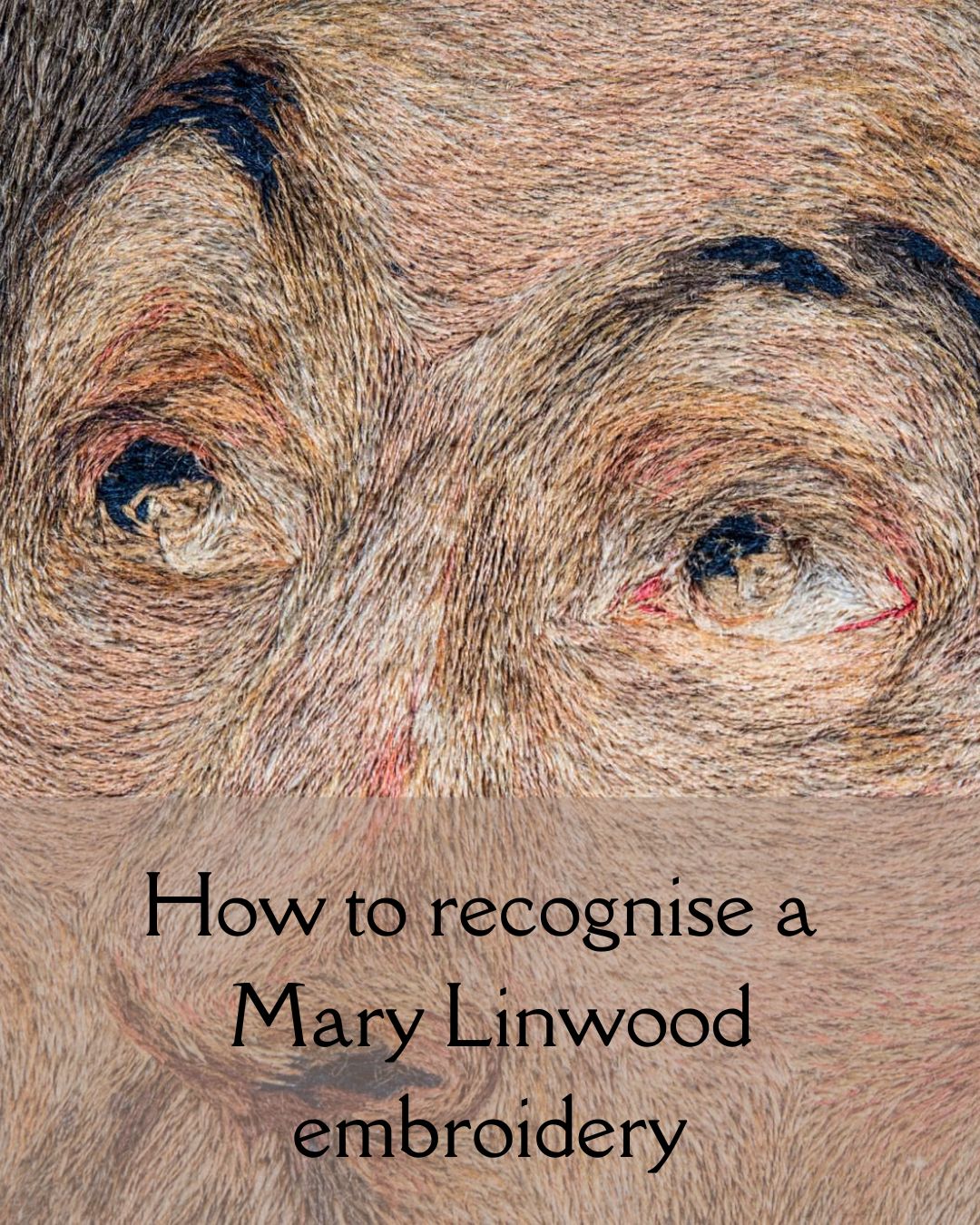
I’ve included these two close ups to help show the difference in the stitching style of Mary Linwood (left) and another unknown embroiderer (right). Linwood used a wide range of thicknesses of thread, hundreds of shades and, particularly on faces, very tiny stitches to create shaping and shading. The piece on the right does not have the characteristic delicacy and detail of Linwood.
The background and clothing are also indicative – the threads are laid very straight and don’t overlap in the way that Linwood worked.
It’s been fascinating to see how visitors to the exhibition were drawn to some of the pieces that I believe were definitely not by Linwood and have shared them saying how wonderful her stitching was. I wonder if I didn’t make it clear enough in the labelling.
In my online course Embroidered Herstories: Mary Linwood Rediscovered, I have created case studies of over 25 pieces of Mary Linwood’s work including some attributed pieces and shared my reasons behind attribution. I have also created a section on materials and making where I explore in detail the type of threads, stitch patterns and way of working that make Linwood’s work so distinctive. The course content includes close up images, the reverse of some pieces and all my discoveries in studying these pieces in person. I’ve shared a case study of the V&A’s landscape piece on my website too.

Find out more about Mary Linwood in Embroidered Herstories: Mary Linwood Rediscovered, an online course bursting at the seams with Linwood imagery and details of her life and work.
You might also like a copy of my exhibition catalogue Lost Threads. Links to both below.

Embroidered Herstories: Rediscovering Mary Linwood.
Online Course now half price £22.50
I’ve decided to create a lasting legacy of all the research I’ve done for the Mary Linwood: Art, Stitch & Life exhibition and collate it all into a really in-depth exploration of her work.
The course is focussed around her making practice, with masses of images and study of her works. I have also created a detailed account of my research into her making process, the materials and methods, giving you the tools to understand her work better and also try the technique yourself if you wish.
There are essays, recorded talks and loads of additional resources like auction records, exhibition images, documents and her own scrapbook. I’ve put together a recorded talk on my own work inspired by her story too, so the whole course is like an expanded version of the exhibition.
The course is open now and you will have access for a year. You can start any time.

Lost Threads: Mary Linwood’s Legacy by Ruth Singer
60 page A5 booklet covering the Mary Linwood: Art, Stitch & Life exhibition. This catalogue includes image of all the Mary Linwood embroideries featured in the exhibition including several close up details and the reverse of several too. There is also a section on Ruth’s own work for the exhibition.
Now on sale

Leave a Reply