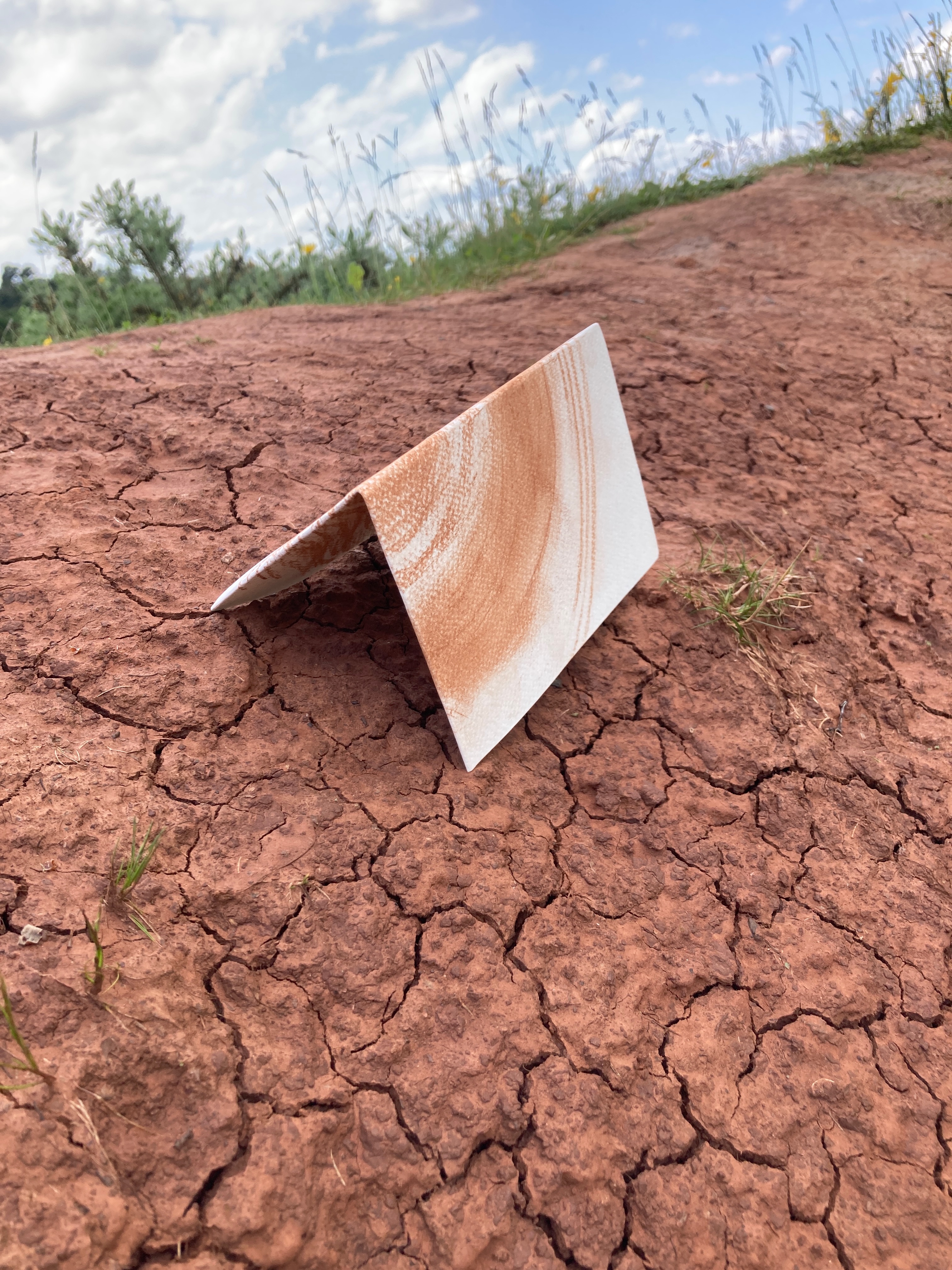
Following the day’s colour prompt, I looked for a summer orange but what I found was an autumn russet, terracotta, brick. Had it been a sunny day, I might have thought of Tuscan roof tiles, glowing at sunset, but on an overcast, post-heatwave day when everything seems faded, it’s brick I see. Good, solid English brick, made from the same heavy, wet clay that plagues my garden. Red brick church, red brick walls, red brick infill and edgings on the local blue-grey slate buildings – these two local minerals sit alongside each other, harmonising in texture and solidity but contrasting in colour. The red bricks sing out from the blue-green-purple-grey of Swithland slate, a stone so complex in colours that it needs its own essay.


Red brick is the material of home. It is the defining building material and colour of many English towns and cities including this one I know so well, built with Loughborough clay. I grew up in red brick Victorian and Edwardian houses then moved to a different clay, the shinier, redder brick of a Manchester terrace. Those bricks always seemed somehow brash, much more fiery and almost glossy as though coated in dried blood. My own terrace too, decades later, was red brick, but back to the Leicestershire-type, a modest and more washed out version of the northern brick.

I painted my front door teal to contrast with the brick, almost like the blue-greens in the local slate that also covered the roof. My house today isn’t red brick. It’s a light clay, yellows and beige and pale washed out terracotta. It feels anachronous to have this imported clay on top of the indigenous red clay which underlies my garden, just below the skimpy soil. It water logs in winter and dries hard and impenetrable in summer. I see it most in the fields, walking through clay slip, better for decorating pottery than growing crops. It’s deep, several inches of slippery terracotta that coats my boots, trousers and sometimes splatters as far as my face when I step in a particularly gloopy bit. This seems a million miles away now in the drought when the field-clay cracks and fissures and nothing is able to grow. The clay is hard enough to draw with now.


I don’t think my soil is right for the underground colour of madder. This plant, a staple of red dye for thousands of years, needs a more forgiving soil. It does not, I think, love it’s colour-matched earth. The roots, full of alizarin, won’t want to sit in wet soil all winter, nor be baked hard in the summer. I don’t know how any roots tolerate it, but the roses seem to be happy, producing their madder pinks and russets in the form of flowers and rosehips. I will try to grow it one day though, in pots or raised beds, so I can experience the magic of this colour with such a long, international history of excellence. I am fascinated by it, by the journey it has taken from Asia into Europe, colouring medieval and early modern textiles in a range of pinks, oranges, russets and even bright, Turkey red beloved by Victorians for it’s wash-fastness. It’s my kind of colour too. It doesn’t have the magic process of indigo or woad but it’s just as special to me for it’s potential and it’s long association with wool, silk and linen. Madder was a core colour in late medieval English cloth which is also my core of knowledge. It’s there in the Lady and The Unicorn tapestries, it’s there in the Bayeux tapestry (which is an embroidery) and it carried on being enormously significant even after the import of other red / pink dyes like cochineal from the 16th century. Madder was imported too, and therefore expensive, but nothing like as expensive as New World dyes.


I’ve most recently seen madder, lots of madder, in Mary Linwood’s work of the late 18th and early 19th century. Her dense and complex hand embroideries were stitched in local wool threads and dyed with both local and distant dyes. Some of her pieces were famous at the time for being dark-toned and that is still apparent in the surviving pieces, even when faded. She clearly loved this range of colours and followed Gainsborough’s lead in using red-browns for deep, dark woodlands. The Woodman, an embroidery from a Gainsborough painting, is the most obvious example. The original painting did not survive long enough to be produced in colour in any other way, so Mary Linwood’s embroidery is the only colour record of the painting. In preparation for my exhibition of her work last year, conservators took the huge embroidery out of it’s heavy and scratched glass to reframe in lightweight conservation perspex. I was able to see it out of the frame and to my delight, also see the back. The Woodman turned out to be less faded that I expected, with much cloudiness coming from the old glass rather than damage to the piece but the back was still noticeably brighter, with much more of the russet, orange, fleshy-pink and warm browns that she and Gainsborough seem to have loved. So much of it must be madder, in a multitude of variations and shades that is so typical of Mary Linwood’s work. She must have had an enormous store of worsted threads to have enough to create such delicate tonal variety; I once tried to count the different colours in a small embroidery and lost the will to count after nearly 40, many of them madder-tones.


I wonder if Mary Linwood’s use of natural madder tones, the orange, brick, flushed-cheek colour, marks the crest of the wave of the popularity of madder in embroidery and in domestic life. Not long after Linwood’s death in 1845, Berlin wool work and its associated synthetic dyes transform the colours of embroidery as well as clothes and furnishings. Turkey red, the pillar box red version of madder, used on cotton, continued to be popular for its colourfastness and washability, but the brick-red, tans and orange-pinks that could be produced on wool and silk had apparently had their day.

Next I’m thinking about the colour pink as an extension of madder but in its own right too.


You might also like my essay on the Absence of Green and my essay on Mary Linwood. If you would like to know more about her, I have an online course with detailed studies of her work, materials and techniques. Find out more on MaryLinwood.co.uk
This essay and a handful of others are on my Substack which you can find here. To keep in touch with more of what I do, I recommend joining my email mailing list which covers exhibitions, events, books and more.
My new book


Tangled: Textile Stories of Care & Connection
Tangled answers the question I get asked the most: “Where do you get your ideas from?” This book includes essays on how I got to where I am now, how museums and heritage are threaded through my work and how the themes of care, connection and history continue to guide everything I make.
Tangled is 150 pages in glorious A4 paperback with photos of almost every piece I have made in the last decade. Printed in the UK.


Leave a Reply